Key takeaways
- Check your HVAC filter every month and change it at least every 3 months. That's ENERGY STAR's rule, and it works for most homes.
- How long a filter lasts depends on its type: thin fiberglass about a month, 1-inch pleated about 90 days, and 4 to 5 inch media filters about 6 to 12 months.
- Pets, a fan that runs all the time, sanding or construction, smoking and wildfire smoke all fill a filter faster.
- The size is printed on the edge of the old filter. Match all three numbers, and point the arrow toward the furnace or air handler.
- The swap takes 2 minutes. Remembering it is the hard part, so put it on a recurring reminder.
How often should you change your HVAC filter? Check your HVAC (heating and cooling) filter every month and change it at least every 3 months. That's the rule from ENERGY STAR, and it fits most homes.
The exact timing depends on the filter you have. A thin fiberglass filter needs changing about every month. A 1-inch pleated filter lasts about 90 days. A 4 to 5 inch media filter can go 6 to 12 months.
HVAC stands for heating, ventilation and air conditioning: your furnace, heat pump or central AC. One filter usually serves the whole system, heat and cooling alike. Fall, when heating season starts, is a good time to check it.
How often to change each type of filter
Change a 1-inch fiberglass filter about every 30 days, a 1-inch pleated filter about every 90 days, and a 4 to 5 inch media filter every 6 to 12 months. Save this table: find your filter in the left column and use the middle column as your schedule.
| Your filter | Change it about every | Change it sooner if |
|---|---|---|
| 1-inch fiberglass (flat, see-through) | 30 days | It looks gray or dusty before then |
| 1-inch pleated (folded, like an accordion) | 90 days | You have pets, dust or heavy use: every 1 to 2 months |
| 4 to 5 inch media (thick, in a cabinet at the furnace) | 6 to 12 months, by maker | The fan runs all day: check it at 6 months |
| 4 to 5 inch MERV 16 or carbon media (Aprilaire's numbers) | 6 months | It turns from white to dark gray |
| Any filter during wildfire smoke | More often than the label says | It looks dirty when you check |
Look at the filter every month. If it looks gray or dusty, change it, whatever the calendar says.
Where the numbers come from:
- ENERGY STAR: check monthly, and change at least every 3 months.
- EPA: makers typically recommend replacing filters every 60 to 90 days.
- Filtrete: at least every 3 months for 1-inch filters, every 12 months for 4-inch and thicker.
- Aprilaire: once a year for its MERV 10 to 13 media filters, every 6 months for MERV 16 and carbon.
- Honeywell: every 6 months to a year for its whole-house media filters, depending on use.
When your filter's box gives a different number, follow the box. Whatever your number is, put it on a recurring reminder. HouseSpouse has a monthly filter check in its built-in plan. To use your own interval, add a task and choose how often it repeats.
How do I know which filter I have?
Pull the filter out and look at two things: the material and the depth.
- Fiberglass: a flat, thin web of fibers you can see light through. It's the cheapest kind and sits at the bottom of the MERV rating scale.
- Pleated: paper-like material folded into ridges, usually in a cardboard frame.
- Media filter: 4 to 5 inches deep, sitting in a metal cabinet right next to the furnace or air handler. Brands like Aprilaire and Honeywell make these.
The depth is the third number in the size printed on the frame. A filter marked 16x25x1 is 1 inch deep. One marked 20x25x5 is a media filter.
What makes a filter get dirty faster?
A filter fills faster when more dust and hair pass through it, or when the system runs more. Plan to check more often if any of these apply:
- Pets. Fur and dander load a filter quickly. Filtrete lists pets as a reason to change the filter more often.
- A fan that runs all the time. If your thermostat fan is set to "On" instead of "Auto," air is moving through the filter around the clock.
- Construction, sanding or remodeling. Drywall and wood dust load a filter fast. Filtrete lists construction and sanding as reasons to change it more often.
- Smoking indoors. Filtrete lists smokers in the home as a reason to change more often.
- Wildfire smoke. The EPA says to plan on replacing the filter more often than the maker recommends during heavy smoke.
- Peak heating and cooling months. Your system runs the most in winter and summer, so the filter fills fastest then.
If someone in your home has allergies or asthma, a filter with a higher MERV rating catches more of the small particles in the air. The EPA suggests at least MERV 13 if your system can take it.
How do I find my filter size and MERV rating?
Size. The size is printed on the edge of the filter frame, as Trane notes. It's written as width x height x depth (for example, 20x25x1). Take a photo of it before you throw the old filter away. That's the number you'll buy every time.
The printed size is rounded. The actual filter is usually a little smaller so it slides into the slot. That's normal. If your filter has no label, measure the slot and round to the nearest common size, and match the depth exactly.
The EPA says the filter should fit snugly, with no gaps for air to leak around, and you shouldn't have to bend it to fit.
MERV rating. MERV stands for Minimum Efficiency Reporting Value. It runs from 1 to 16, and a higher number catches smaller particles. Thin fiberglass filters rate about 1 to 4.
The EPA suggests choosing at least MERV 13, or the highest rating your system's fan and filter slot can handle. It says most furnaces and HVAC systems can use a MERV 13 filter without problems, provided you change it often. Your system probably isn't labeled with a limit, so if you're unsure, ask an HVAC technician at your next tune-up.
Where is my HVAC filter?
Most homes keep the filter in one of two places:
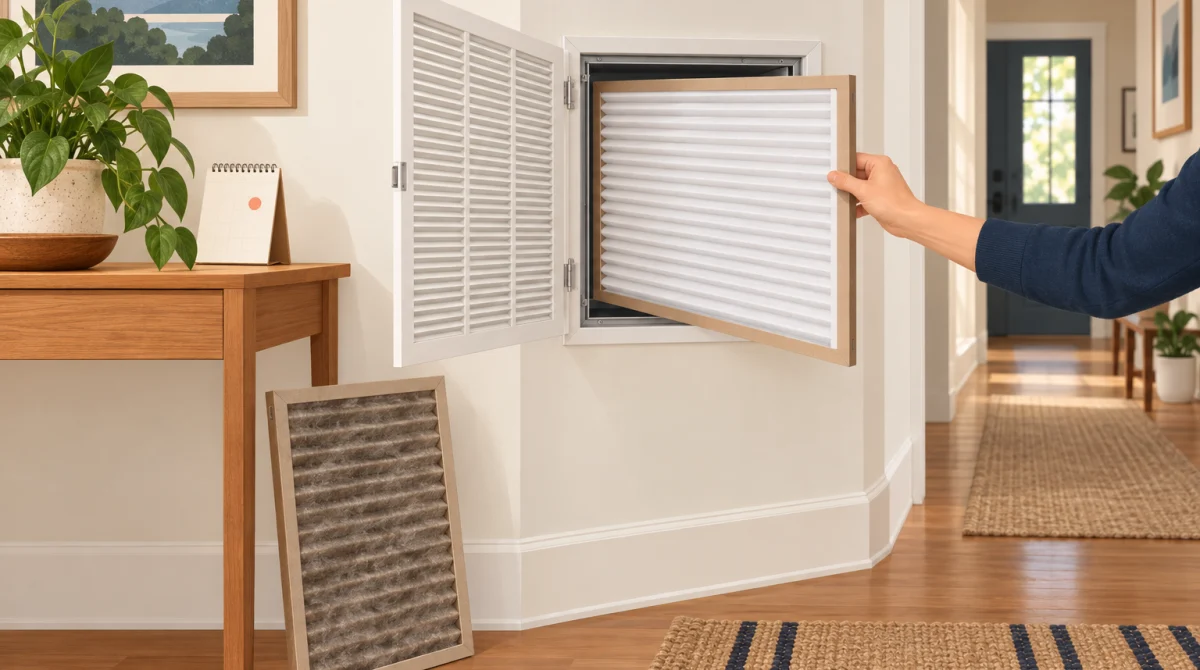
- Behind a return grille in a wall or ceiling inside your living space. It's the large vent with a hinged cover, often in a hallway. Return grilles pull air in. They don't blow air out.
- At the furnace or air handler, in a slot on the side or bottom where the big return duct connects.
Some homes have more than one return grille with a filter, so check each large grille. If you find a filter at the furnace and another at a grille, ask a technician whether you need both.
How do I change an HVAC filter?
Changing a filter takes about two minutes and no tools.
- Turn the system off at the thermostat so the blower doesn't start while the slot is open. Trane lists this as the first step.
- Slide out the old filter and note which way its arrow points.
- Check the size on the frame, and snap a photo if you haven't yet.
- Slide in the new filter with the arrow pointing toward the blower, which means toward the furnace or air handler. On a wall or ceiling grille, the arrow points into the wall or ceiling, toward the duct.
- Close the cover, turn the system back on, and write the date somewhere you'll see it next time.
What happens if you don't change your filter?
A dirty filter makes your system work harder. ENERGY STAR says a dirty filter can raise energy costs and damage your equipment, leading to early failure. A clogged filter can also let dirt slip past it. That dirt builds up on the indoor cooling coil and cuts its ability to absorb heat, as the Department of Energy's former air conditioner maintenance guide explained.
In other words, a filter is cheap protection for one of the most expensive systems in your house.
Make the filter change stick
The swap takes two minutes. Remembering to do it every month or every 90 days, for years, is the hard part. That's the mental load of homeownership in one small job.
HouseSpouse handles the remembering. Its built-in plan includes a monthly filter check and nudges you when it's due. Want a different interval? Tap New task, then set Repeats to Every 3 months. Mark it done right from the notification.
Snap a photo of the filter's size label into a note under Appliances. Type the size into the note too, so it's one search away when you're standing in the store. Keep your furnace's details and warranty in the same place. Our guide to organizing home warranties, receipts and manuals shows a simple setup.
The filter is one of the monthly checks in our seasonal home maintenance checklist, and one of the first jobs on our new homeowner maintenance checklist. While you're in the utility closet, it's a good time to find out how old your water heater is too.
If you're weighing other apps, we compared the best home maintenance apps, free ones included.
You can try HouseSpouse free for 14 days on the yearly plan (7 days on monthly). After that it's $59.99 a year or $8.99 a month, on iPhone.
Your two-minute task for today: pull out your filter, photograph the size on its edge, and decide when you'll change it next.
Frequently asked questions

Written by
HouseSpouse Team
HouseSpouse is built by a team led by real-estate professionals who've helped homeowners care for and sell their homes. We write practical, judgment-free guides to make home maintenance feel manageable, no matter how handy you are.
Put this checklist on autopilot
HouseSpouse builds a personalized seasonal plan for your home, reminds you at the right time, and answers any maintenance question, 24/7. Start your free trial.
