Key takeaways
- Flush a tank water heater about once a year, and about every 6 months if you have hard water. That's Rheem's guidance.
- Turn off the power or gas first, close the cold water supply, open a hot tap, and drain through a garden hose to a drain lower than the tank.
- The drained water can be hot enough to scald. Turn the heat off ahead of time and keep people and pets clear of the hose.
- Refill the tank completely before you turn the power or gas back on. Rheem's manual and the Department of Energy's Building America guide both say the tank must be full first.
- Call a plumber instead if the tank is old and has never been flushed, or if the drain valve won't open or is leaking.
To flush a tank water heater, turn off its power or gas and close the cold water supply. Open a hot tap, then drain the tank through a garden hose until the water runs clear. Refill it completely before the heat goes back on, and repeat about once a year (every 6 months with hard water), as Rheem recommends.
If your tank is old and has never been flushed, read when not to flush first. Not sure of its age? Here's how to read it from the serial number.
How often should you flush a water heater?
Flush a tank water heater about once a year. With hard water, flush it about every 6 months. Those are Rheem's numbers, and A. O. Smith also says most tanks should be flushed at least once a year, more often in hard water areas.
Save this schedule. It covers the regular jobs a water heater needs, with the source for each one.
| Task | How often | Source |
|---|---|---|
| Flush a tank water heater | About once a year | Rheem, A. O. Smith |
| Flush a tank with hard water | About every 6 months | Rheem |
| Drain a few quarts from the tank (optional) | Monthly | Rheem electric owner's manual |
| Test the T&P relief valve | At least once a year | Rheem owner's manual |
| Check the anode rod | Once a year | Rheem owner's manual |
| Descale a tankless water heater | At least once a year, more with hard water | Rinnai, Rheem |
| Check the water temperature setting (120°F) | Each time you flush | CPSC (for 120°F) |
Your owner's manual is the final word for your model. If it gives a different interval, follow the manual. To have it remembered for you, add a task in HouseSpouse and set how often it repeats.
Not sure if your water is hard? On city water, check the annual water quality report that the EPA requires community water systems to send customers. If it doesn't list hardness, call the utility and ask. On a private well, a water test will tell you.
Why does a water heater need flushing?
A tank water heater collects sediment. Rheem's owner's manual explains that the tank acts as a settling basin, so hard water deposits build up on the bottom.
Flushing clears that sediment, and Rheem says it helps prevent corrosion and improves heating performance. A rumbling or popping sound as the tank heats is a common sign of sediment. It's also one of the signs a water heater is near the end of its life.
How to drain and flush a tank water heater, step by step
These steps work for gas and electric tank water heaters. They follow Rheem's owner's manual and a step-by-step guide from the Department of Energy's Building America Solution Center, written by Pacific Northwest National Laboratory. Check your own manual too, because some models differ.
You'll need: a garden hose long enough to reach a floor drain or the outdoors, thick gloves, safety glasses, and a few towels.
- Turn off the heat. On an electric water heater, switch off its breaker at your electrical panel. On a gas water heater, turn the gas control knob to OFF or PILOT, whichever your manual says. Don't leave a gas control on a normal setting, because the burner could fire while the tank is draining.
- Let the water cool. A. O. Smith says to turn the heater off a few hours before you drain it, so the water cools and the scald risk drops. Waiting longer is fine.
- Close the cold water supply valve. It's on the cold pipe going into the top of the tank. Most tanks mark the fittings HOT and COLD on top, or check your manual.
- Open a hot water tap in the house, ideally on a floor above the tank. This lets air into the tank so it can drain. Leave it open.
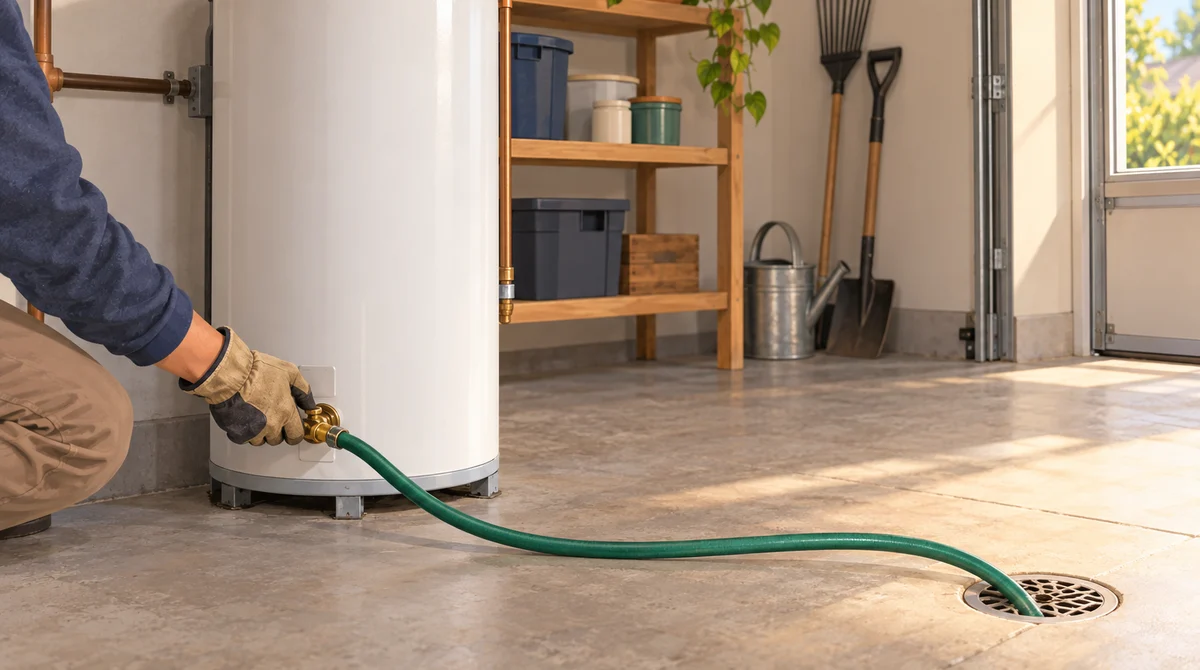
- Attach the garden hose to the drain valve near the bottom of the tank. Run the other end to a floor drain or outdoors. The Solution Center says the hose must end lower than the bottom of the tank.
- Open the drain valve and let the tank empty. Put on your gloves and glasses first. Keep kids and pets away from the hose, because the water can still be hot.
- Stir up the sediment. Once the flow slows or stops, open the cold water supply valve for about 10 seconds, then close it. The rush of water loosens sediment on the bottom. Repeat until the water from the hose runs clear.
- Close the drain valve and take off the hose.
- Refill the tank. Open the cold water supply valve, with the hot tap still open. The tap will sputter as air comes out. When it runs in a steady stream, the tank is full and you can close the tap.
- Turn the heat back on, but only now. Switch the breaker back on, or turn the gas control back to its normal setting. If your pilot went out, follow the manufacturer's relighting instructions, as A. O. Smith advises.
- Check the drain valve for drips over the next day. The tank will take several hours to reheat, and the water may look cloudy at first, so the Solution Center suggests waiting before you run laundry.
If the drain valve clogs with sediment, the Solution Center suggests opening and closing it a few times. If that doesn't clear it, stop and call a plumber, as A. O. Smith advises.
Is flushing a water heater dangerous?
Flushing is safe when the heat is off, the water has cooled, and the tank is full again before the heat comes back on. The risks are burns from hot water and damage to the heater.
- Scalding. Rheem's manual warns that drained water can be hot enough to scald. The CPSC says most adults get third-degree burns in 2 seconds at 150°F and in 6 seconds at 140°F. Let the water cool, wear gloves, and aim the hose at a drain.
- Dry firing an electric element. Rheem's manual says the tank must be full of water before the heater is turned on. Its warranty doesn't cover damage from running with an empty or partly empty tank. The Solution Center adds that a water heater that turns on empty can be damaged quickly.
- Gas. If you smell gas, leave the house and call your gas company or 911 from outside. If you aren't comfortable relighting a pilot, stop and call a plumber. Rheem lists being unsure about gas or electrical parts as a reason to call a pro.
While you're at the tank, check the temperature too. The CPSC urges setting water heaters to 120°F to lower the risk of most tap water scalds.
When should you not flush a water heater?
Don't flush it yourself if the tank is old and has never been flushed, or if the drain valve won't open or is leaking. Call a plumber instead.
- An old tank that has never been flushed. Rheem says older tanks can hold hardened sediment that's hard to remove without special tools, and a do-it-yourself flush could lead to leaks or more damage. It suggests calling a professional for tanks 8 to 12 years old or older. Some plumbers advise leaving a very old, never-flushed tank alone, HomeTips reports, because the sediment may be plugging small corrosion spots inside.
- A drain valve that's stuck or already dripping. Rheem lists a drain valve that won't open or is leaking as a reason to call a pro. Don't force a stiff valve. A valve that cracks or won't close again leaves a leak that needs a plumber.
- A leak at the base of the tank. A tank that leaks from the bottom usually can't be fixed, and flushing won't help. Plan the replacement. Our guide to your water heater's age covers the other warning signs.
- A heater still under warranty, if you're unsure. Rheem notes that some do-it-yourself maintenance can affect a warranty, so check your manual for jobs that need a licensed technician.
How do you flush a tankless water heater?
A tankless water heater has no tank to drain. Instead, it needs descaling: you pump a cleaning solution through it to dissolve mineral scale. Rheem says tankless units need periodic descaling instead of flushing.
- How often: Rinnai says to remove mineral deposits at least once a year. Rheem says hard water calls for more frequent service.
- What to use: Rinnai calls for 4 gallons of undiluted white vinegar and says never to use chemical cleaning solutions. A. O. Smith uses a descaling solution and kit. Use what your manual names.
- How long: about 45 minutes of circulation. Rinnai says up to 45 minutes and A. O. Smith says usually 45, but times vary by model.
The job involves closing the unit's service valves and running a small pump, so many owners have a plumber do it with the yearly service. Follow your own model's manual either way. Some newer A. O. Smith models need to be put in a service mode first.
What about the anode rod and the relief valve?
Two other parts deserve a yearly look while you're flushing: the anode rod and the T&P (temperature and pressure) relief valve.
- Anode rod. This metal rod inside the tank corrodes on purpose so the tank doesn't. Rheem's manual says to remove it once a year for inspection and replace it when more than 6 inches of its core wire shows. Turn off the cold water supply first. Rheem's maintenance guide says inspecting or replacing the anode rod is best left to a qualified plumber, so that's a fine choice too.
- T&P relief valve. This safety valve near the top of the tank opens if pressure or temperature gets too high. Rheem's manual says to lift and release its lever at least once a year, letting water flow out through the discharge pipe to a drain. Keep everyone clear of the pipe's end, since that water is hot, and replace a valve that won't release or keeps leaking afterward, as Rheem advises.
Make the yearly flush stick
Flushing a water heater is easy to forget because you only do it once a year. That's the mental load of homeownership in one job.
HouseSpouse carries the remembering. Its built-in plan can include a yearly flush for tank water heaters and reminds you when it's due. With hard water, tap New task and set Repeats to Twice a year. You can mark it done, snooze it, or reschedule it right from the notification.
Each time you flush, add a quick note under Maintenance with the date and how the water looked. Snap a photo of the tank's rating label into a note under Appliances, and keep the warranty with it.
Our guide to organizing home warranties, receipts and manuals shows a simple setup. Hear a new rumble or see rust at the base? Send a photo to the assistant and ask what it means.
The flush is one of the fall jobs in our seasonal home maintenance checklist and a yearly task on our new homeowner maintenance checklist.
Still choosing a tool? See our comparison of the best home maintenance apps.
You can try HouseSpouse free for 14 days on the yearly plan (7 days on monthly). After that it's $59.99 a year or $8.99 a month, on iPhone (prices as of October 2026).
Your two-minute task for today: find your water heater's drain valve and cold water shutoff, and set a yearly flush reminder, in HouseSpouse or on your calendar.
Frequently asked questions

Written by
HouseSpouse Team
HouseSpouse is built by a team led by real-estate professionals who've helped homeowners care for and sell their homes. We write practical, judgment-free guides to make home maintenance feel manageable, no matter how handy you are.
Put this checklist on autopilot
HouseSpouse builds a personalized seasonal plan for your home, reminds you at the right time, and answers any maintenance question, 24/7. Start your free trial.
