Key takeaways
- Clean gutters at least twice a year: once in spring and once after the leaves finish falling. State Farm gives the same baseline.
- Pine trees, heavy tree cover, gutter screens and wildfire risk all call for more frequent cleaning. Gutter guards cut the work but don't end it.
- A CDC study of workers found nearly 90% of nonfatal ladder falls were from under 16 feet. A one-story gutter deserves real ladder care.
- Set an extension ladder about 1 foot out for every 4 feet of height, and let it reach 3 feet past the gutter. Those numbers come from OSHA's ladder rule.
- Keep your ladder at least twice its own length from overhead wires. The CPSC gives that distance for metal and wood ladders and advises fiberglass near any wire. If you can't, hire a pro.
Clean your gutters at least twice a year: once in spring and once in late fall, after the leaves have finished dropping. That is State Farm's baseline. Homes under pines or heavy tree cover need it more often, and every cleaning should start with a safe ladder setup.
How often should you clean gutters?
Twice a year is the floor. Trees, gutter guards and climate decide how far above that you go. Save this schedule; each row names its source.
| Your situation | How often to clean | Source |
|---|---|---|
| Most homes, few trees near the roof | Twice a year, spring and late fall | State Farm |
| Pine trees near the roof | About four times a year | Angi |
| Heavy leaf fall from overhanging trees | Check often during peak leaf fall, up to weekly | This Old House |
| Micro-mesh or reverse-curve gutter guards | Once or twice a year | This Old House |
| Screen gutter guards | 2 to 4 times a year | This Old House |
| Brush or foam gutter inserts | 3 to 4 times a year | This Old House |
| Cold winters with hard freezes | Make sure gutters are clean before winter | Department of Energy, Building America |
| Wildfire-prone area | Keep gutters free of debris year-round, since they sit in the 0 to 5 foot zone around the house | Texas A&M Forest Service (Firewise) |
| After a severe storm or high winds | Look at the gutters once it's safe | Bob Vila |
| Downspout outlets | Check that water exits at least 5 feet from the foundation | Department of Energy, Building America |
If your house has gutters, HouseSpouse already puts the twice-a-year baseline on your list for you, in April and November.
Clogs matter because overflowing water lands next to the foundation. The Department of Energy's Building America Solution Center says that runoff can saturate the soil, wick through the foundation, and lead to mold and rot.
Signs your gutters need cleaning now
These signs come from Bob Vila's gutter guide.
- Water spills over the gutter edge during rain.
- Little or no water comes out of the downspouts during a steady rain.
- Leaves or debris stick up above the gutter line.
- Plants are growing in the gutter. That means cleaning is overdue.
- A gutter sags or pulls away from the house.
- Water pools near the foundation, mulch washes away, or streaks run down the siding.
Can you clean gutters from the ground?
Yes, on many one-story houses. Ground tools keep both of your feet on the ground, which is the safest place to be.
Bob Vila's tested roundup of gutter cleaners covers three main types. They are hose wands, leaf blower gutter kits and wet or dry vacuum attachments.
Wear eye protection, because debris falls back toward you. Ground tools get harder to aim on a second story, and you still need to check each downspout.
How to clean gutters by hand, step by step
These steps build on State Farm's guide, with the wire, ladder and downspout points from the CPSC, OSHA and the Building America guide. They are for a one-story gutter you can reach safely.
- Pick a dry, calm day. Skip the job when the rungs are wet or the wind is up.
- Dress for it. Wear a long-sleeve shirt and work gloves.
- Look up first. Find every overhead wire near your work area, including the line from the street to your house.
- Set the ladder on firm, level ground, following the ladder rules in the next part of this guide.
- Start at a downspout. Clear the area around the downspout opening first so water has somewhere to go.
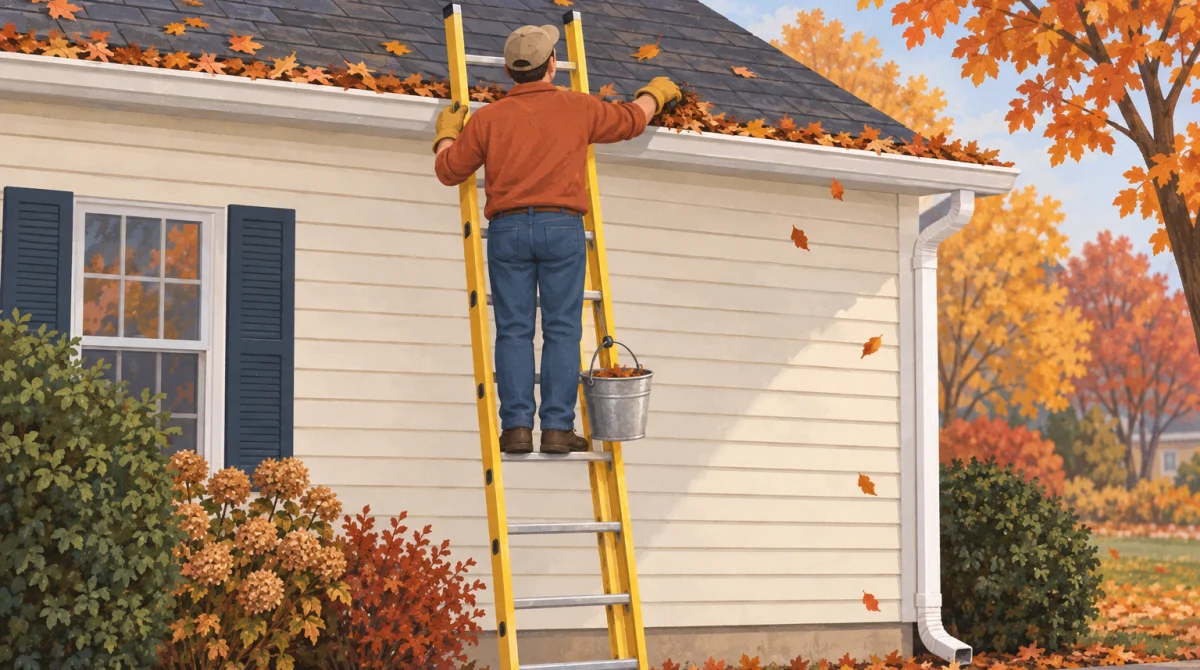
- Scoop the debris. Use a gutter scoop or garden trowel. Drop it into a bucket hung on the ladder or onto a tarp below.
- Move the ladder often. Climb down and move it rather than leaning out.
- Rinse the gutter. Run a garden hose from the far end toward the downspout and watch the water flow.
- Clear the downspout. If water backs up, push the hose up into the downspout from the bottom outlet, or feed it down from the top.
- Check the outlets. Make sure each downspout empties at least 5 feet from the foundation, per the Building America guide. Add an extension if it doesn't.
What are the ladder safety rules for cleaning gutters?
Set an extension ladder 1 foot out for every 4 feet of height and extend it 3 feet past the gutter. Keep it at least twice its length from any overhead wire. Among workers, the CDC found that nearly 90% of nonfatal ladder falls were from under 16 feet, so a one-story gutter deserves real care.
The rules come from OSHA's ladder standard, 29 CFR 1926.1053, the CPSC and the American Ladder Institute:
- Use the 4-to-1 angle. Set the base about 1 foot out from the wall for every 4 feet of height up to where the ladder rests on the house. OSHA's rule puts the base one-quarter of the working length away.
- Extend 3 feet past the gutter. OSHA requires side rails to reach at least 3 feet above the upper landing. State Farm says the same for gutters.
- Stand on stable, level ground. OSHA says ladders go only on stable, level surfaces unless they're secured.
- Face the ladder and keep a grip. OSHA requires you to face the ladder and hold it with at least one hand while climbing. The American Ladder Institute teaches three points of contact: two feet and one hand, or two hands and one foot.
- Never stand on the top step of a stepladder. OSHA forbids it.
- Don't carry a load that throws off your balance. Hang a bucket from the ladder instead of holding it.
- Stay twice the ladder's length from overhead wires. For metal and wood ladders, the CPSC says the nearest overhead line should be at least twice the length of the ladder away. Metal ladders conduct electricity, so the CPSC advises fiberglass with non-conductive rails near any wire. Keep the same distance with any ladder.
- Assume every overhead wire is live. The CPSC notes that power lines and phone lines look alike, and coatings on lines don't protect you. It counted 15 consumer electrocution deaths from ladders touching wires around the home from 2000 to 2009.
Have someone home while you're on the ladder.
When should you hire a gutter cleaner?
Hire a pro when the ladder rules can't make the job safe:
- Two-story or steep roof lines that need a tall extension ladder or roof walking.
- Overhead wires within twice your ladder's length of any spot you'd set it.
- No firm, level ground under the gutter, like a slope, soft beds or a deck edge.
- Gutters that sag or pull loose and need repair, not just cleaning.
- You'd be alone, or you feel unsteady on a ladder for any reason.
Keep the gutter schedule without thinking about it
Gutters are easy to forget until water pours over the edge, which is the mental load of homeownership in one job.
If your house has gutters, HouseSpouse already puts "Clean and Inspect Your Gutters" in its built-in plan twice a year, in April and November. It announces the task in your Monday plan. Each April the plan also adds "Check Grading and Drainage Around Your Foundation," which includes a look at every downspout.
Need more than twice a year because of pines? Add your own gutter check from the New task button on your task list, set Repeats to Every 3 months, and tap Add task. Spot a sagging gutter or a stain on the siding? Send a photo to the assistant and ask what it means.
Gutters are one of the fall jobs in our seasonal home maintenance checklist and part of the spring routine in our new homeowner maintenance checklist. While you're on fall chores, our furnace filter guide covers the job inside.
Comparing apps? Our roundup of the best home maintenance apps covers free and paid options.
You can try HouseSpouse free for 14 days on the yearly plan (7 days on monthly). After that it's $59.99 a year or $8.99 a month, on iPhone (prices as of October 2026).
Your two-minute task for today: walk outside, look up at your gutters, and note any overhead wires near where a ladder would go.
Frequently asked questions

Written by
HouseSpouse Team
HouseSpouse is built by a team led by real-estate professionals who've helped homeowners care for and sell their homes. We write practical, judgment-free guides to make home maintenance feel manageable, no matter how handy you are.
Put this checklist on autopilot
HouseSpouse builds a personalized seasonal plan for your home, reminds you at the right time, and answers any maintenance question, 24/7. Start your free trial.
